
Iran Signals Deterrence as Talks With Washington Hang by a Thread
Shamkhani, a senior Iranian national security figure framed negotiations as possible but made clear that Iran is preparing for a wider confrontation if talks fail.

Only days after the interview, and during a sensitive week of indirect talks between Iran and the United States, Ali Shamkhani appeared in a rare, carefully staged television interview wearing his naval uniform. The timing and presentation were widely read as deliberate signaling, not coincidence.
Soon after, Iranian President Masoud Pezeshkian issued a presidential decree appointing Shamkhani as secretary of the Supreme Defense Council, according to state media. The council’s mandate includes strengthening defense readiness, confronting emerging threats, and improving coordination in defense decision making across military and security institutions.
While US military posturing in the region has been visible and loud, Tehran has responded with a coordinated mix of promotion, enforcement actions, and strategic signaling.
The elevation of Ali Shamkhani, a long regarded hardliner who survived an alleged Israeli assassination attempt, coincided with a series of assertive moves by Iran’s Islamic Revolutionary Guard Corps.
This week, the IRGC seized two oil tankers with foreign crews near Iran’s Farsi Island in the Gulf, accusing them of “smuggling fuel” after an alleged intelligence-led naval operations. Iranian media reported that more than one million liters of fuel were confiscated and 15 foreign crew members were referred to the judiciary, though the vessels’ flags and crew nationalities were not disclosed. These seizures followed a familiar pattern amid heightened tensions, as Iranian forces regularly target tankers linked to illicit fuel trade through the Strait of Hormuz.
At the same time, Iran briefly revealed footage of an underground IRGC missile base housing the long range Khorramshahr-4 Medium-Range Ballistic Missile (MRBM), with its l,800 kg warhead.
The message was also reinforced by senior military figures, including the armed forces chief of staff, who warned that any war would engulf the region and that Iran seeks only victory, not restraint. Against this backdrop of naval enforcement, missile signaling, and hardened rhetoric, Shamkhani’s interview functioned as the political articulation of a broader deterrence posture unfolding across multiple domains.
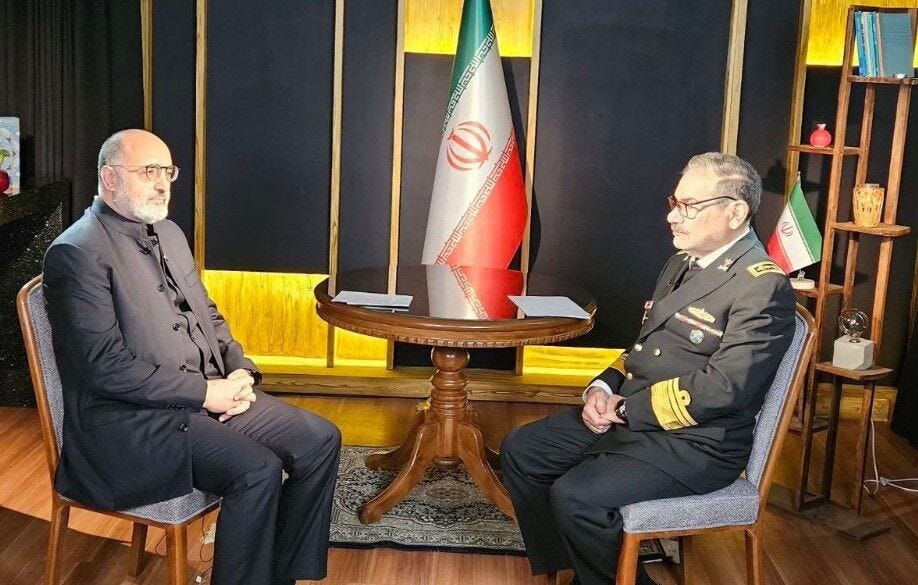
Shamkhani is one of Iran’s most prominent national security figures. He previously served as secretary of the Supreme National Security Council and held senior military commands, including leadership of Iran’s naval forces. Prior to his promotion he served as political adviser to Supreme Leader Ali Khamenei.
The interview delivered a clear message. Iran is preparing for war while still preferring a negotiated outcome. The two tracks are meant to reinforce each other.
The interview delivered a clear message. Iran is preparing for war while still preferring a negotiated outcome. The two tracks are meant to reinforce each other.
From the opening moments, Shamkhani framed the situation as one where diplomacy and military readiness move together. “We are not pushing toward war,” he said. “But we are fully prepared to accept it if it is imposed on us.”
His decision to appear in uniform was central to the signal. “I am a military man,” he said. “The region is under threat. When the atmosphere is military, we dress accordingly. This is a political message and a military one. We are ready.”
He stressed that readiness does not mean provocation. “Readiness does not mean seeking war,” he said. “It means accepting war if forced upon us.”
According to Shamkhani, Iran is already operating under wartime pressure. “War is not only the exchange of fire,” he said. “Psychological pressure, economic warfare, military encirclement. We are living under war conditions already.”
One of the key points was his rejection of any separation between Israel and the United States. “There is no division in our doctrine,” he said. “Israel and America are not two different entities. They are one reality.”
Asked directly whether Iran would respond to Israel if attacked by the United States, he answered without hesitation. “Yes. Certainly. Israel would be part of the response.” When pressed again, he repeated, “Yes. Israel would be struck.”
He added a qualifier meant to reinforce deterrence rather than escalation. “Our response will be defensive and proportional,” he said. “But it will happen. The scale depends on their actions.”
Shamkhani warned that any future conflict would not remain limited. “If war is imposed this time, it will become a regional war,” he said. He explained that Iran could not confine its response geographically. “The enemy’s military deployment is spread across the region,” he said. “Threats do not come from one point.”
Reflecting on the previous 12 day conflict, he said restraint had failed. “We learned that restraint did not work in our favor,” he said. “That lesson has been fully absorbed.”
On maritime escalation, he confirmed the central role of naval forces. “Yes, the sea is one of the theaters of war,” he said. “Naval warfare means targeting the enemy’s naval capabilities and pressure points.”
He revealed that Iran had deliberately held back. “There are capacities we have not tested yet,” he said. “They were not used in the twelve day war.”
Despite the military framing, he emphasized that diplomacy remains possible. “The door to negotiation is open,” he said. “But only with the United States, and only on the nuclear file.”
He dismissed Europe’s role. “Europe proved it cannot act independently,” he said. “After 2018, they failed completely.”
On the format of talks, he said, “Indirect talks can create understanding. If understanding forms, direct talks are natural.” But he repeated two conditions. “No threats. And no irrational orders.” He added, “If they come with threats and dictates, there will be no agreement.”
On Iran’s nuclear program, Shamkhani denied any military intent. “We did not enrich uranium for weapons,” he said. “There is no program, no intention, and no storage of nuclear weapons.” He cited Iran’s religious ruling. “Producing, storing, or using nuclear weapons is forbidden.”
At the same time, he demanded reciprocity. “If we do not pursue weapons,” he said, “there must be a political and economic return.”
He rejected claims of internal fragility. “They invested heavily in that scenario,” he said, referring to efforts to provoke unrest. “They wanted the streets empty. Instead, people appeared.”
In his closing remarks, Shamkhani aimed his message outward. “In forty seven years, we have never started a war,” he said. “We do not want to change that.”
He accused Israel of sabotaging diplomacy. “Israel wants chaos,” he said. “We want stability with dignity.”
Shamkhani ended with a final line meant to leave no ambiguity. “We will not surrender,” he said. “And we will not be forced into a war we did not choose.”